
AquaOil srls
Via Terracina 27, 00177 Roma (Italia)
C.F. - P.IVA - № registro imprese 16213571009
Numero REA RM - 1641982
www.aquaoil.info – pec : aquaoil@pecodc.it
Email: info@aquaoil.it
Telefono: +39 349 342 3348
Applied research for innovation and development
AquaOil
NON-ELECTROLYTIC PLANT FOR THE PRODUCTION OF GREEN HYDROGEN FROM WATER
an innovative technology based on the use of cold plasma
Hydrogen current applications and development
Hydrogen is a key element in the transition to more sustainable energy.
Several sectors are interested in hydrogen end-uses.
Mobility (maritime, rail, material handling equipment, buses and trucks, light mobility with fuel cells and light goods vehicles)
Industry (as an alternative to traditional fuels due to its low emissions; in the synthesis of chemicals, e.g. ammonia and methanol; in petroleum refining; in hydrogenation processes for hydrocarbons to increase octane and thus for higher added value; in the direct reduction of iron ore for steel production; as a fuel for high-temperature industrial processes, e.g. in treatment furnaces for steel, ceramics and glass)
Residential (for winter thermal energy generation).
Infrastructural (in energy distribution in the gas grid sector).
The hydrogen market is expanding rapidly, with numerous investments in research and development to improve efficiency and reduce production costs.
In the future, hydrogen could become a key component of a low-carbon economy, transforming not only the energy sector, but also the way we produce and use energy in general.
There are some positive and beneficial factors for using hydrogen as an energy carrier.
For example, the high energy density per unit mass and the absence of carbon dioxide emissions or climate-changing and polluting emissions. Or the possibility of storing hydrogen in different forms, such as liquid, gaseous or solid and liquid (with metal hydrides and organic liquids). And the possibility of exploiting existing infrastructure for transport and distribution, with lower order costs than power lines for the same amount of energy transported. Not to mention the shorter recharging times for combustion cell vehicles compared to those needed for battery-powered vehicles, as well as greater autonomy.
Current technologies
Today, more than 95 per cent of hydrogen is produced from fossil sources, mainly through the “Steam Reforming” of natural gas (methane), which results in the emission of carbon dioxide from the process.
Current hydrogen production technologies differ in their characteristics, efficiency and environmental and economic limitations.
Natural gas reforming: This method, which uses methane and steam at high temperature, is the most common and has an efficiency of approximately 65-75%. However, it emits a significant amount of CO2, contributing to climate change. It is relatively cheap, but dependence on fossil fuels is a significant environmental constraint.
Electrolysis of water: This process uses electricity to split water into hydrogen and oxygen, with an efficiency of 60-70%. If the electricity comes from renewable sources, the hydrogen produced is “green” and has a very low environmental impact. The main limitation is the high cost, due to the need for renewable electricity and the relative inefficiency of the process.
Coal or biomass gasification: This method converts carbonaceous materials into hydrogen with an efficiency of 45-55%. It can be improved with carbon capture and storage (CCS), reducing CO2 emissions. However, it is an expensive and complex process, with a significant environmental impact if CCS is not implemented effectively.
Biological production: Uses microbes to produce hydrogen through natural processes. This technology is still in the experimental stage and has variable but generally low efficiency. Research and development costs are high, and the scale of production is currently limited.
Thermal cracking of hydrocarbons: This process breaks down hydrocarbon molecules into hydrogen and other compounds at high temperatures. It has an efficiency of 50-60% and, although less common, has a high energy cost and produces significant CO2 emissions.
In summary, while natural gas reforming is the cheapest and most common method, electrolysis is the most sustainable long-term option, despite its high costs. Other technologies, such as gasification and biological production, offer potential innovative solutions, but require further development to become economically and environmentally sustainable.
The innovation
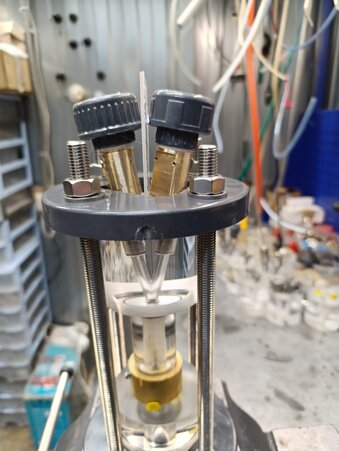
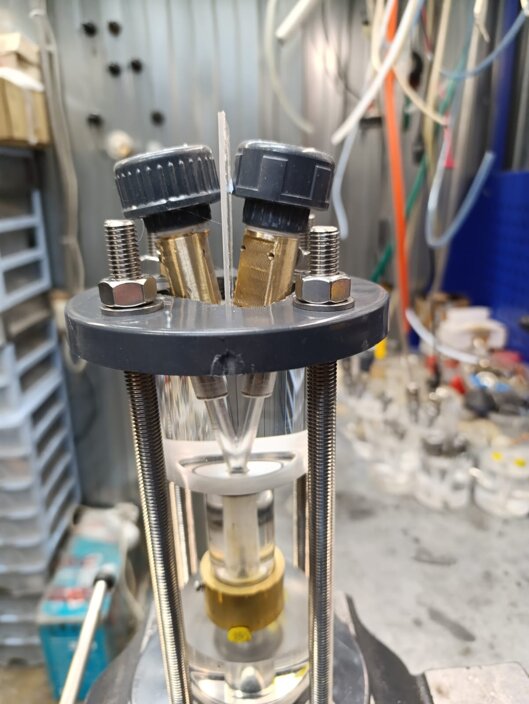
This is a new hydrodynamic technological process that consists of igniting the plasma directly in the flow of a two-phase fluid mixture, composed of water and gaseous steam, to immediately split the molecular components and separate hydrogen from oxygen. This technology has already been validated for other purposes, in particular for water purification and drinking water purification, and is now undergoing advanced testing for the separation of the elements that make up water and for product purity.
The two-phase mixture is obtained through the hydrodynamic action and cavitation imparted by the special construction of the nozzles entering the reactor, in transonic regime due to the pressure surge in the vacuum zone of the reactor itself.
Plasma (essentially an ionised gas) is generated by means of high-voltage electrical discharges between electrodes located in the reaction chamber in transonic regime. It acts completely on the entire liquid to be treated and not only on the surface exposed to air, as current systems can do.
The physico-chemical phenomena triggered by the hydrodynamic and cavitational action together with the cold plasma (non-equilibrium, i.e. non-thermal) produce, in the fluid to be treated, powerful combined effects of sonoluminescence, shock waves, photon emission of light radiation of different wavelengths (radiation of all frequencies of the spectrum, from ultraviolet to infrared) and a very special “electrolysis” of the water, contributing to molecular splitting.