
AquaOil srls
Via Terracina 27, 00177 Roma (Italia)
C.F. - P.IVA - № registro imprese 16213571009
Numero REA RM - 1641982
www.aquaoil.info – pec : aquaoil@pecodc.it
Email: info@aquaoil.it
Telefono: +39 349 342 3348
Applied research for innovation and development
AquaOil
WATER PURIFICATION WITH COLD PLASMA
This is a new method for the disinfection and purification of water that allows the complete oxidation and elimination of organic material and different microbiological cultures (bacteria, viruses, fungi, other pathogens, etc.) present in the water, thanks to a transonic cold plasma treatment without the use of reagents and chemicals and with low energy consumption.
The innovation consists in igniting the (cold) plasma directly in a two-phase fluid mixture (water and gaseous vapour).
The plasma, generated directly in the liquid (water or even other substances) by means of high-voltage electrical discharges, makes it possible to act completely on the entire substance to be treated and not only on the surface exposed to the air, as current systems can do.
Cold plasma
Plasma is basically a (ionised) gas composed of electrically charged particles that, unlike other gases, are in continuous motion. It is called cold (i.e. non-thermal or non-equilibrium) because the electrons and ions that make it up have different temperatures. The ions maintain an ambient temperature, while the electrons reach 10,000 degrees. A thermal imbalance that allows minimal heat concentration and operation at ambient temperatures.
The electric field, which is generated between two electrodes, accelerates the movement of the electrons, which are torn from their nuclei, leaving them to move chaotically and freely in the gas until they collide with the atoms. By removing the electrons, ions and free radicals remain, which are oxidising agents with a bactericidal effect.
The physico-chemical phenomena triggered by cold plasma produce powerful cavitational hydromechanical effects, together with sonoluminescence, shock waves, molecular splitting with separation of oxidising agents and free radicals with a bactericidal effect, photon emission of light radiation of different wavelengths (rays of all spectrums, from ultraviolet with oxidising power to infrared) and a special electrolysis of water.
Various results are thus obtained:
- the decay of the charge and resistance of the cell membrane of the bacteria in the water, which become more vulnerable;
- the arrest of the process of cell division and thus of the micro-organisms' ability to reproduce;
- the breakdown of water components and the formation of unstable molecules of ozone, atomic oxygen and hydroxyl groups, which are the most powerful oxidants of organic materials and enable the disinfection of water from any cryptogamic and fungal cultures, without the need for chemical reagents;
- finally, silver ions, of which the plasma ignition electrodes can be composed, help to stop the process of splitting and reproduction of organic molecules, and thus of bacteria, for longer after treatment.
The process
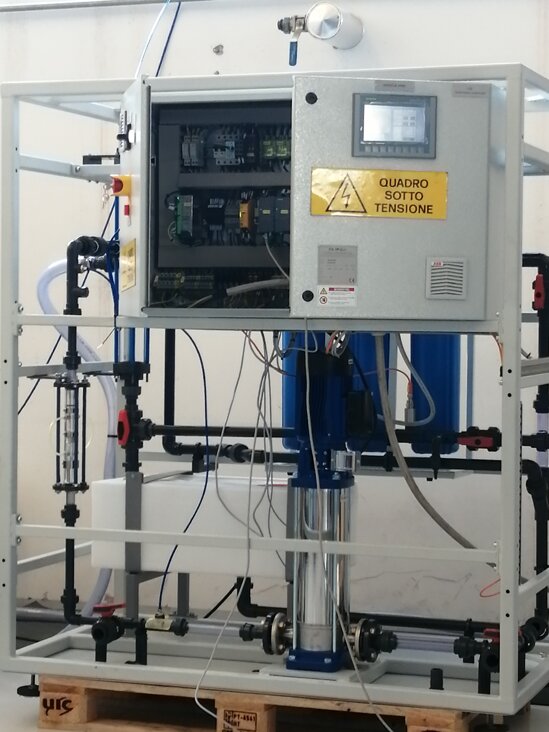
The water, after passing through the filter block, which removes solid and larger impurities, is pushed by a pump to a pressure of about 10 bar, which is necessary to start the process in the reactor.
The stream of water then enters, at ambient temperature, the plasma reactor, the transonic flow apparatus (due to the high pressure in a vacuum zone) where the plasma is ignited, which streaks through the water/steam gas mixture and releases the oxidising components.
The water, thus disinfected, is then collected for use, while the gases (basically oxygen and hydrogen) are sent and separated in a degasser (deaerator: gas separator or outgassing).
System sizes and consumption
The system is characterised by its small size and low energy requirements.
- Flow rate: 1.5 m3/h. Consumption: 700 W for the pump and instrumentation; 900 W for the plasma.
- Flow rate: 5 m3/h. Consumption: 3 kW for pump and instrumentation; 1 kW for plasma.
- Flow rate: 10 m3/h. Consumption: 5.5 kW for pump and instrumentation; 1 kW for plasma
This technology is particularly useful for solving health and water supply problems, especially in developing countries and in emergency circumstances. It can also be used in the final stage of wastewater purification and can be combined with photovoltaic systems if necessary.